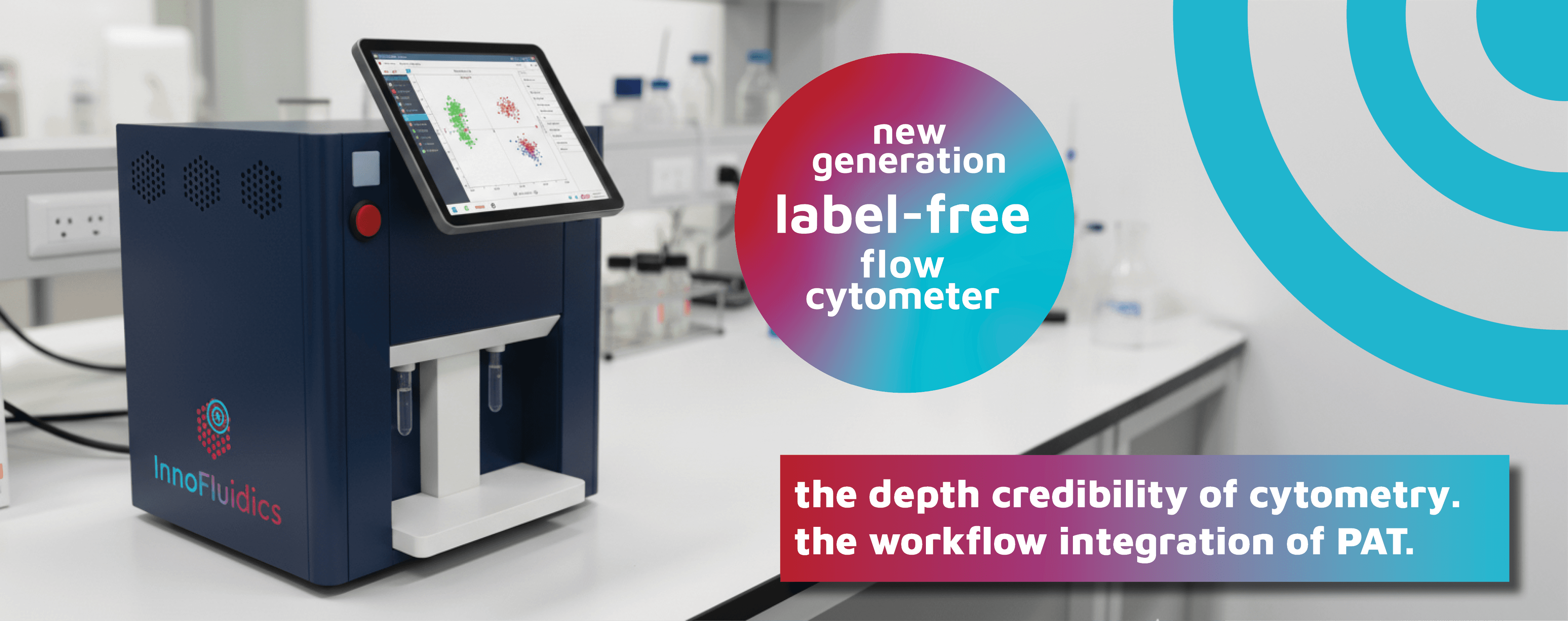
The hardware foundation of Agentic Bioprocessing™
A bioprocess analytical instrument built on measurement physics that generates data no other system produces.
powered by InnoFluidics' proprietary microfluidic technology
The Information Lag: A Multimillion-Euro Blind Spot
During bioprocessing, the cell (simultaneously the bioreactor, the catalyst, and the product) is a black box. pH, dissolved oxygen, optical density are signals from the environment around the cell, not from the cell itself. Every intervention is reactive. Every optimisation is empirical. By the time extracellular data indicates a change, the biological event has already passed.
Indirect and fragmented data

Poor data quality
Limited information based on surrounding medium parameters.

Low data quantity
The need for combining multiple, often non-complementary, techniques.

Model-driven approach
Very complex and indirect chemometric models.
A New Paradigm: Real-time intracellular intelligence
The only platform that sees, understands, and remembers cell biology in real time, during manufacturing. The intracellular intelligence is built on 136 independent physical parameters directly captured from each cell during active bioprocess operation.
Real-time and rich data on cell state
Direct, label-free analysis
Non-invasive, multi-parameter measurements at intact state. No sample preparation.
Single, comprehensive data stream
One unified stream of real-time data, eliminating the need for combining multiple & incompatible analytical techniques.
Instrument-invariant cell data
Transfer-function-free normalization: pure cell data. No instrument noise. No drift. No calibration.
The technology foundation
A new kind of data
Bioprocess teams have lived with two separate tools. Flow cytometry, the offline gold standard for cell-state characterisation. Process analytical instruments, used in real time, for reading the medium around the cell. Neither can deliver what Agentic Bioprocessing™ requires: direct, real-time, intracellular data, structured for interpretation.
Our measurement is not a better version of either. It is a different kind of data. A single coupled signal, phased across multiple biological layers of each cell, captured continuously during the process. This is the measurement foundation on which Agentic Bioprocessing™ is built, and it did not exist before.
The measurement generates physically coupled data across the dielectric spectrum of the cell. Adjacent frequency channels probe overlapping cellular structures, so the relationships between them encode as much information as the channels themselves. Virtual Sensors translate these frequency regimes into named cellular compartments: geometry, membrane, cytoplasmic metabolism, and nuclear architecture. The Dispersion Interaction Tensor captures the full coupling structure across all channel pairs, yielding 136 independent physical parameters per cell from a single label-free measurement.

The hardware that generates it
Agentic Bioprocessing™ is only possible when the data beneath it is rich enough to interpret. That is not a software problem; it is a measurement problem. The data we require did not exist, so we built the instrument that generates it.

Our system sits in the flow cytometer family — cells flow single-file through a sensing region — but replaces lasers and fluorescent labels with low-voltage electrical signals applied at multiple frequencies simultaneously. Different frequencies reach different depths inside the cell. Measured together, they form the coupled intracellular fingerprint shown above.
Reading at this depth is not a property of impedance cytometry in general. It is the product of the specific hardware we built: a proprietary three-dimensional electrode geometry, a full-glass microfluidic chip, and a high-frequency signal architecture that reaches cellular compartments beyond the limits of conventional impedance systems.
The Instrument
Ready for your lab. Built for the bioreactor.
Every part of this system is designed for bioprocess deployment. No sample preparation, no specialist operator, no calibration routine. Fresh cells from the bioreactor, loaded directly, measured in minutes, data handled automatically.
The plug-and-play benchtop instrument serves as an off-line or at-line analytical tool — the fastest path to intracellular data in a process development lab today. The same measurement architecture evolves into a native in-line PAT probe, carrying the full depth of the bench instrument — the Dispersion Interaction Tensor, the 136 parameters per cell — directly to the bioreactor. A change in form factor, not in capability.
Available now. Deployable in your lab.
Already generating data for partners.
Where it leads
This instrument is the foundation. On top of it, we have built an intelligence architecture that turns every measurement into a decision your process can act on.
Follow us on LinkedIn:
InnoFluidics:

InnoFluidics Diagnostics: